Harvard Medical School
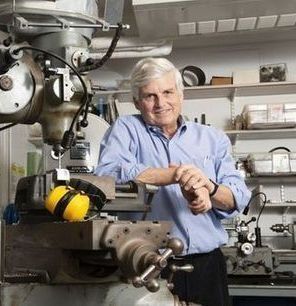
Dr. David Corey, Harvard Medical School
David Corey, PhD, is the Bertarelli Professor of Translational Medical Science, Blavatnik Institute of Neurobiology, Harvard Medical School. After years of studying the role of protocadherin 15, the Usher 1F gene, in hearing, he decided to pursue research on treating the vision loss of Usher 1F after attending Usher 1F Collaborative's May 2017 researchers symposium. Dr. Corey is working on three approaches to gene therapy, mini genes, split genes, and gene editing, with his mini gene the most advanced and demonstrating very promising results in preclinical testing. We are very grateful to the Bertarelli Foundation, Foundation Fighting Blindness, and the Blavatnik Family Foundation for providing a substantial amount of funding for Dr. Corey's Usher 1F work.
Read more about Dr. Corey's research.
Watch a presentation by Dr. Corey about his Usher 1F research.
Read more about Dr. Corey.
Read more about Dr. Corey's Usher 1F gene therapy - here, here and here.
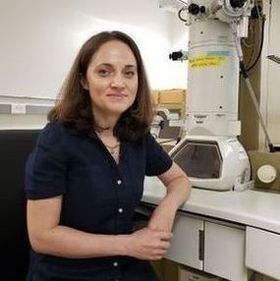
Maryna Ivanchenko, MD, PhD
Read an interview with Maryna Ivanchenko, MD, PhD, who has spearheaded much of the Usher 1F research in Dr. Corey's lab.
Publications
Mini-PCDH15 gene therapy rescues hearing in a mouse model of Usher syndrome type 1F
Rescue of hearing by adenine base editing in a humanized mouse model of Usher syndrome type 1F
PCDH15 Dual-AAV Gene Therapy for Deafness and Blindness in Usher Syndrome Type 1F
PCDH15 Dual-AAV Gene Therapy for Deafness and Blindness in Usher Syndrome Type 1F Models
Mini-Pcdh15b Gene Therapy Rescues Visual Deficits in a Zebrafish Model of Usher Syndrome Type 1F
University of Oregon Institute of Neuroscience
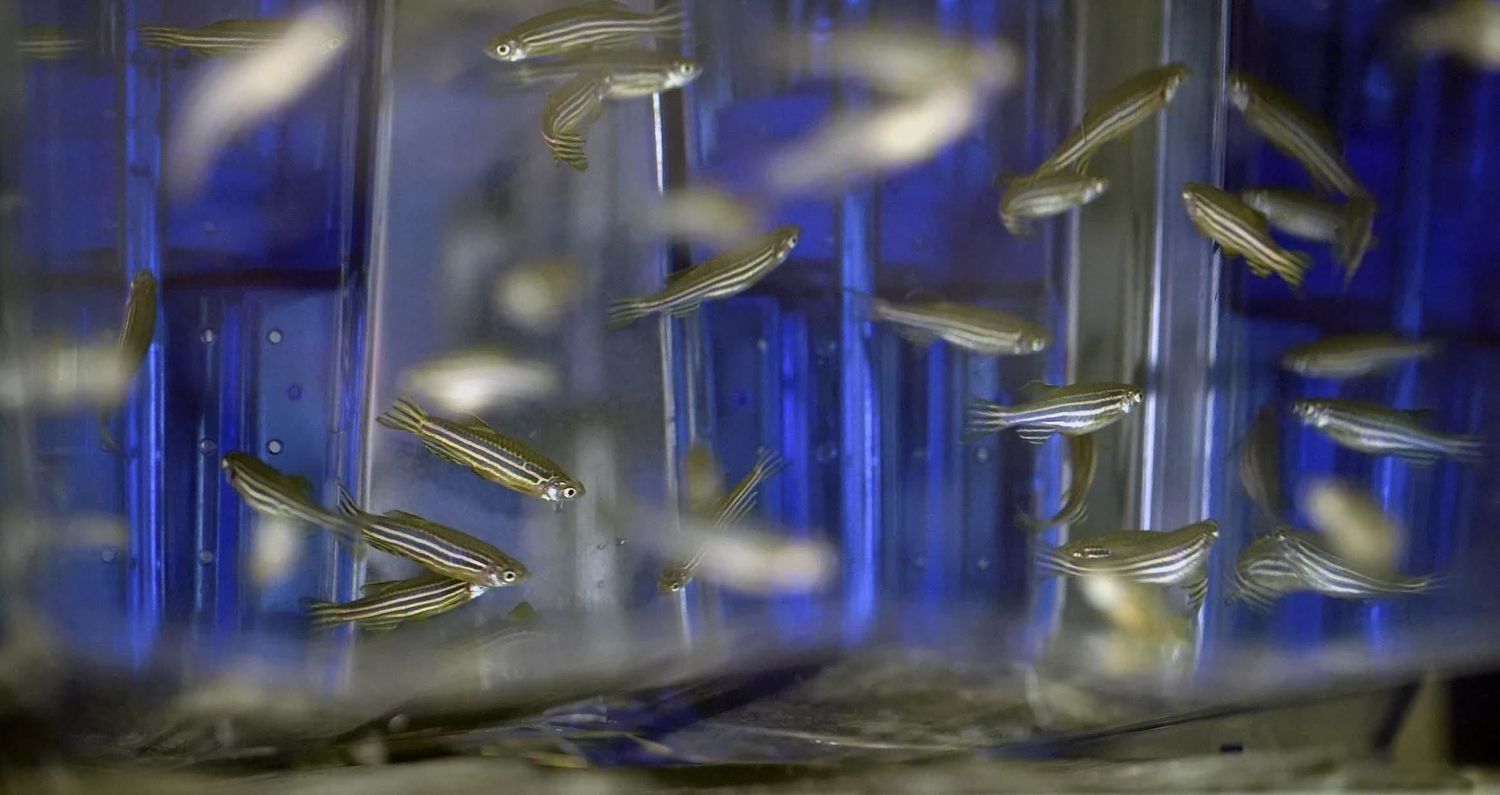
Monte Westerfield, PhD, is at the Institute of Neuroscience and Department of Biology at the University of Oregon. His research is focused on Usher Syndrome with particular expertise in creating zebrafish models of Usher Syndrome mutations. Usher 1F Collaborative has funded the creation of a zebrafish model of the Usher Syndrome Type 1F R245X mutation that is carried by ~2% of those of Ashkenazi Jewish descent. Dr. Westerfield and his team, including Jennifer Phillips, Ph.D., are now beginning testing of drugs on our zebrafish that have the potential to halt or slow the progression of vision loss.
Read more about Dr. Westerfield’s research, click here.
View a presentation explaining and outlining the progress of the work of Dr. Monte Westerfield and his lab associates that Jennifer Phillips, Ph.D., presented at the Usher Syndrome Family Conference in Seattle on July 9, 2016.
Watch an Usher Syndrome Coalition USH Talk with University of Oregon Usher 1F researcher Jennifer Phillips, Ph.D., on gene therapy for Usher Syndrome.
Read an interview with Jennifer Phillips, PhD., on what drives her to continue her Usher 1F research.
PHOTO CREDIT: (Photo at top of the page) Courtesy of University of Oregon
Publications
The Salk Institute
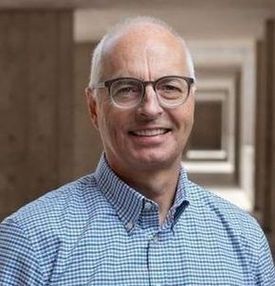
Samuel Pfaff, PhD
The Salk Institute
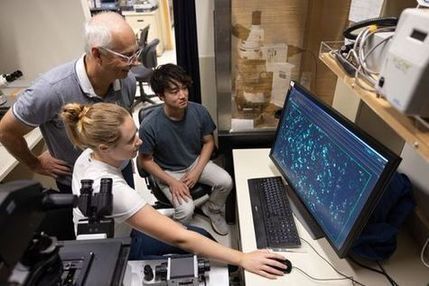
Pfaff Lab, Salk Institute: Sam Pfaff, Claire Williams, Ryan Hsu
Samuel Pfaff, PhD, and his team at the Salk Institute for Biological Studies in La Jolla have developed a novel RNA joining technology to enable a new generation of gene therapies for large genes. In the work funded by Usher 1F Collaborative, they are developing and testing a PCDH15 gene replacement approach for the treatment of Usher 1F.
Read more about Dr. Pfaff's research.
University of Alberta
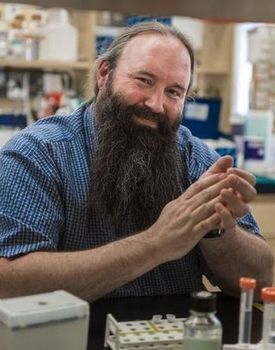
W. Ted Allison, PhD
University of Alberta
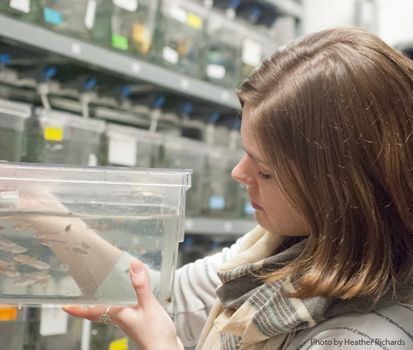
Allison Lab, University of Alberta, Michelle Heather-Richards
Ted Allison, PhD, a zebrafish research scientist, is the most recent addition to our Usher 1F research team. Funded by Usher 1F Collaborative Canada, he will be working with our University of Oregon team to evaluate drugs for repurposing to slow the pace of vision loss in patients with Usher 1F.
Read more about Dr. Allison's research.