We work to find a cure for Usher 1F so that all those affected will be able to realize a future with their vision.
Our success is measured by the research we are able to fund and inspire and in the pace of that research, with treatments in development that have the potential to move from the lab to clinical trials in single digit years. These programs are fueled by our dedicated group of caring volunteers and generous donors like you.
Research Overview
Since its founding, the Usher 1F Collaborative has invested $6 million in research aimed at finding treatments for Usher 1F. In addition, our scientific collaborators have leveraged this support to secure more than $9 million in external grant funding, bringing the total investment in Usher 1F research to more than $15 million.
With the goal of preserving the vision of individuals living with Usher 1F, we are currently funding two complementary approaches, two gene therapies and drug repurposing.
-
Gene Therapy: Replacing the Mutated Gene
Our first approach delivers a new copy of the mutated gene, protocadherin-15 (PCDH15), using an adeno-associated virus (AAV) as the delivery vehicle. Because AAVs have a limited cargo capacity, the PCDH15 gene is too large to fit into a single vector. To overcome this challenge, David Corey, PhD, and Maryna Ivanchenko, MD, PhD, of Harvard Medical School developed a “mini-gene.”
Preclinical testing has demonstrated rescue of hearing, vision, and balance in our mouse and zebrafish models. While it is unlikely that the mini-gene will restore hearing in humans born profoundly deaf, particularly given the substantial benefit already provided by early cochlear implantation, our priority is preserving vision in people with Usher 1F.
Further preclinical studies in nonhuman primates yielded results described as “stunning” and “exquisite.” Analysis showed that the gene reaches the precise retinal cells where it is needed and produces the protein essential for vision. We are actively working to advance this gene therapy into human clinical trials.
Our second gene therapy approach, developed in the laboratory of Samuel Pfaff, PhD, at the Salk Institute for Biological Studies, addresses the challenge of delivering the large PCDH15 gene by splitting it into two parts that reassemble into a full-length gene once in the retina using a state-of-the-art technology known as RNA End-Joining (REJ). The Salk team is collaborating closely with our Harvard investigators, and early studies in our mouse model are producing highly encouraging results.
-
Drug Repurposing: Screening Approved Drugs for Efficacy
Since our founding in 2013, one of our goals has been to conduct a high-throughput screen of existing drugs to identify treatments for Usher 1F. Although no currently available medication can restore vision by replacing the missing protein caused by the underlying mutation, drug therapy may target key disease mechanisms, such as inflammation or oxidative stress, and meaningfully slow the progression of vision loss.
Importantly, identifying a drug already approved for another condition would represent the fastest path to patients since its safety profile is already well established. Such a treatment could buy valuable time while gene therapies progress toward clinical trials.
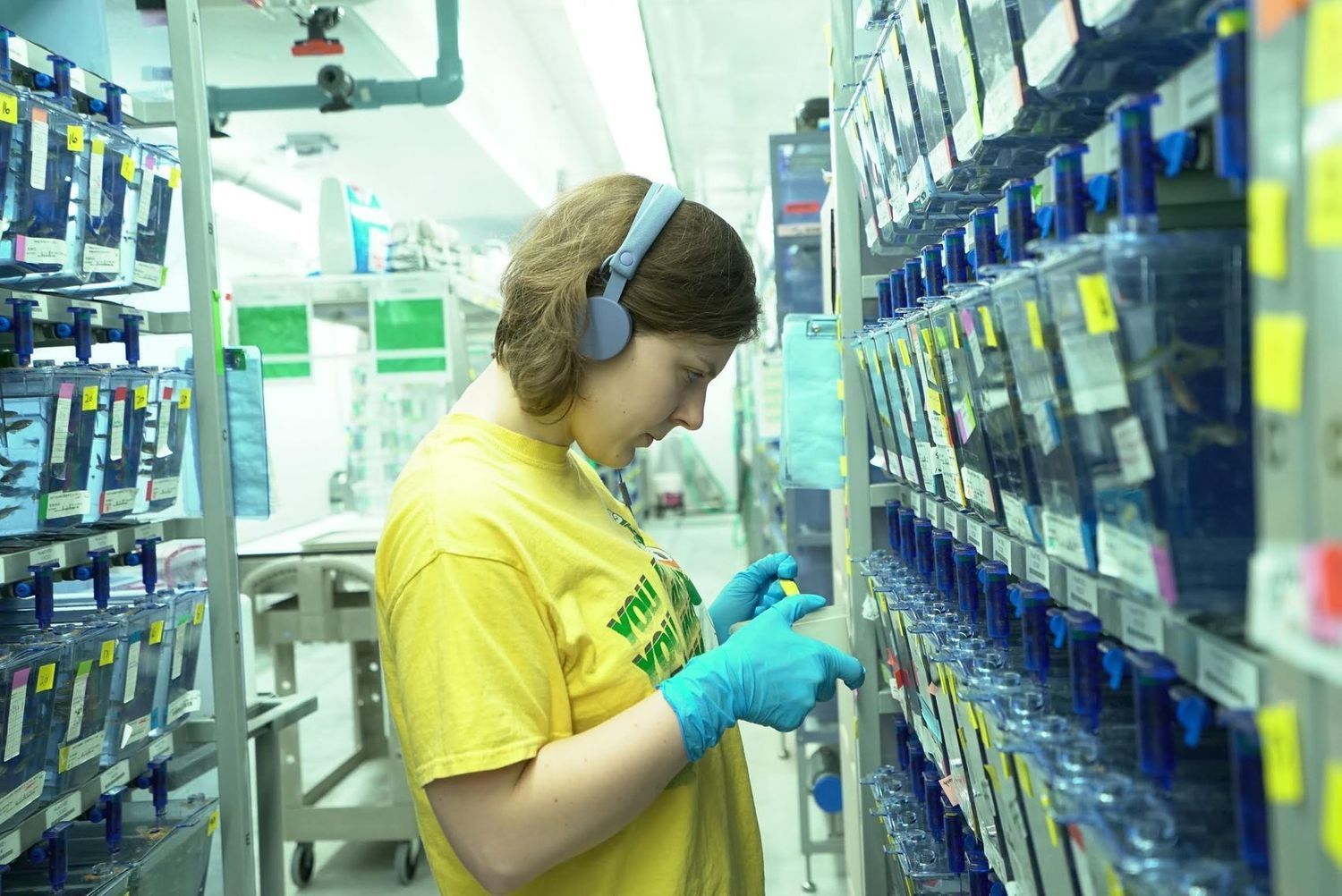
Several years ago, we launched our first drug repurposing initiative using our zebrafish model, partnering with a contract research organization to screen a library of 1,800 FDA-approved compounds. Despite its promise, the projected cost, approximately $1.3 million annually over two to three years, ultimately made the effort financially unsustainable, and the project was placed on hold.
Fast forward to 2026, and the landscape has changed dramatically. Advances in artificial intelligence have created new opportunities to accelerate and scale scientific discovery. Through our partnership with Unravel Biosciences, we were able to revisit drug repurposing in a way that was previously out of reach, screening approximately 40,000 compounds in just three months at a tiny fraction of the original cost.
In December 2025, we received a prioritized list of candidate compounds, with nine drugs emerging as the most promising. We have since engaged two leading zebrafish research laboratories to advance this work:
• Dr. Monte Westerfield's laboratory at the University of Oregon Institute of Neuroscience, which developed our zebrafish model and has been a longstanding partner
• Dr. Ted Allison's laboratory at the University of Alberta, supported by Usher 1F Collaborative CanadaWe are now entering a critical next phase: determining whether these candidate drugs can meaningfully slow vision loss in our zebrafish model and, ultimately, whether they hold promise for people living with Usher 1F.
What once seemed financially and logistically out of reach is now moving forward with unprecedented speed, precision, and real possibility. If even one of these compounds demonstrates efficacy, it could dramatically shorten the timeline to treatment, bringing us closer to a future in which vision loss from Usher 1F can be slowed and lives meaningfully improved.